Leadership. Understood.

Understanding how leadership actually works. 

Across individuals, teams, boards, and organizations.

Why LeaderLens?

Leadership shapes results, culture, and risk – every day, across the organization.
The challenge is not whether leadership matters, but understanding how it actually works at different levels: in your own leadership, in leadership teams, and throughout the organization.

LeaderLens helps you gain a clear, experience-based view of leadership as it is practiced — beyond models and assumptions; enabling alignment from individual leaders to teams and the wider organization, and helping you reach the outcomes you are aiming for.

Why Leadership Must Be Understood, Not Assumed
Leadership is one of the most discussed topics in organizations — and one of the least understood. Most organizations operate with implicit assumptions about leadership: what it looks like, how it works, who has it, and how it should be developed. These assumptions are rarely tested. Instead, leadership is often inferred from position, personality, or past performance, rather than understood as a set of observable behaviors shaped by context, role, and situation. The result is a gap between how leadership is perceived and how it actually functions in practice. LeaderLens starts from a simple but demanding premise: leadership must be understood before it can be developed, changed, or relied upon. Without a structured understanding of leadership as it is enacted day to day, decisions about development, succession, team composition, or organizational change are made with limited visibility and high risk. Understanding leadership does not mean defining an ideal. It means making leadership visible as a reality — across individuals, teams, and organizations.
How Organizations Relate to Leadership Today
In many organizations, leadership is handled indirectly. It is discussed in abstract terms, evaluated through isolated assessments, or addressed through generic development programs. Feedback is often episodic, context is lost, and comparisons are difficult or impossible. Over time, leadership becomes something organizations talk about, but rarely see clearly. This creates several structural risks. Organizations may overestimate leadership capability in critical roles, misunderstand the dynamics within leadership teams, or fail to detect leadership-related risks until they materialize in performance, culture, or execution problems. At the same time, strong leadership behaviors may remain invisible or underutilized because they are not systematically observed or understood. LeaderLens addresses this gap by shifting the relationship organizations have with leadership — from assumption and intuition to observation, interpretation, and evidence.
Leadership as a Value and Risk System
Leadership is one of the strongest drivers of organizational value. It shapes decision-making, execution, trust, culture, and long-term resilience. At the same time, leadership is also one of the most significant sources of organizational risk. Leadership is often described as “soft” — not because it lacks impact, but because its effects are indirect, distributed, and difficult to measure. Until they are not. When leadership fails, the consequences are concrete: delayed decisions, broken execution, loss of trust, and erosion of value. Misaligned leadership teams, unclear authority, poor judgment under pressure, or leadership behaviors that do not match the organization’s context can undermine strategy long before problems appear in financial results. LeaderLens treats leadership as a system that simultaneously creates value and risk. This system operates across levels — individual leaders, leadership teams, boards, and the organization as a whole. Understanding this system requires more than opinions or snapshots; it requires structured insight over time and across contexts.
Leadership Under New Conditions
The conditions under which leadership is exercised have changed fundamentally. Artificial intelligence and automation are reshaping decision-making and accountability. Hybrid and remote work have reduced informal signals and increased reliance on structure and consistency. Post-pandemic organizations operate with less stability, faster change, and fewer shared reference points. At the same time, generational shifts are altering expectations around authority, motivation, and meaning at work. These changes do not prescribe a new leadership ideal. They make leadership harder to read. Signals that once indicated leadership effectiveness are weaker or ambiguous. Behaviors that worked in one context may fail in another. As uncertainty becomes permanent rather than temporary, leadership is tested continuously rather than episodically. Under these conditions, relying on assumptions, personal impressions, or generic models becomes increasingly risky. What organizations need is not more opinions about leadership, but better ways to understand how leadership actually functions under real conditions. This is the context in which LeaderLens exists.
A Leadership Intelligence Company
LeaderLens is a leadership intelligence company. That distinction matters. We are not a traditional leadership consultancy offering opinions, frameworks, or one-off assessments. We are not a software company selling tools in search of problems. And we are not an academic institution producing theory disconnected from organizational reality. LeaderLens exists to help organizations understand leadership as it actually functions, in real contexts, under real conditions, over time. We focus on leadership as a system of behaviors, decisions, interactions, and consequences — not as an abstract ideal. Leadership intelligence means making leadership: Observable rather than assumed Comparable rather than isolated Interpretable rather than anecdotal Developable rather than generic
Consulting + Software + Data​
LeaderLens is built on three tightly integrated components: consulting, proprietary software, and data. None of them create real value on their own. Together, they form a coherent system. Consulting is the foundation. This is where leadership is understood in depth — through judgment, experience, and context-aware interpretation. Leadership is never just data. It requires sense-making, dialogue, and the ability to distinguish signal from noise. Consulting ensures relevance, credibility, and practical impact. Software is the enabler. Leadership insight cannot scale if it depends on manual processes, fragmented tools, or individual consultants. Our platform provides a single environment where assessments, analysis, visualization, reporting, and follow-up are integrated. It replaces ad hoc workflows with consistency and continuity. Data is the differentiator. Over time, leadership insight becomes more powerful when it can be compared, contextualized, and tracked. All work conducted through LeaderLens contributes to a growing data asset, structured into the Future Leadership Index (FLI). This enables benchmarking, pattern recognition, and learning across organizations, industries, and leadership contexts. Together, these three elements turn leadership from opinion into intelligence.
How the Pieces Work Together
LeaderLens is designed as a closed loop. Consulting creates deep, context-rich understanding of leadership. The platform structures that understanding, making it visible, repeatable, and comparable. Data accumulates over time, strengthening insight, benchmarks, and decision quality. This loop allows organizations to move from isolated leadership initiatives to an ongoing leadership capability. Assessments are no longer endpoints, but starting points. Development is grounded in reality rather than aspiration. Follow-up becomes possible, not optional. Leadership insight compounds rather than disappears after each intervention. LeaderLens does not replace human judgment. It strengthens it. It does not standardize leadership. It contextualizes it. This is what makes LeaderLens a company — not a method, not a tool, and not a point solution — but a system for understanding leadership in a complex and changing world.
Our Point of View on Leadership - It is Contextual
LeaderLens is designed as a closed loop. Consulting creates deep, context-rich understanding of leadership. The platform structures that understanding, making it visible, repeatable, and comparable. Data accumulates over time, strengthening insight, benchmarks, and decision quality. This loop allows organizations to move from isolated leadership initiatives to an ongoing leadership capability. Assessments are no longer endpoints, but starting points. Development is grounded in reality rather than aspiration. Follow-up becomes possible, not optional. Leadership insight compounds rather than disappears after each intervention. LeaderLens does not replace human judgment. It strengthens it. It does not standardize leadership. It contextualizes it. This is what makes LeaderLens a company — not a method, not a tool, and not a point solution — but a system for understanding leadership in a complex and changing world.
From Observation to Understanding
LeaderLens begins with observation. Leadership cannot be understood through assumptions or labels. It must be observed as behavior: how decisions are made, how authority is exercised, how responsibility is taken, how leaders interact with their environment and with each other. Our assessments are designed to surface these patterns. We focus on what leaders do, not what they say they do. Observation creates a shared factual ground from which meaningful understanding can emerge. Understanding leadership does not mean reaching quick conclusions. It means slowing down judgment long enough to see what is actually happening.
Combining Qualitative and Quantitative Insight
Leadership is neither purely qualitative nor purely quantitative. Numbers without interpretation lack meaning. Narratives without structure lack comparability. LeaderLens combines both. Quantitative data helps identify patterns, tendencies, and deviations across individuals, teams, and organizations. Qualitative insight provides depth, nuance, and context. The value lies in how these two are brought together. This combination allows us to distinguish signal from noise — to see what matters, what is situational, and what is structural.
Interpretation and Sense-Making
Interpretation is where leadership insight is created. Data does not speak for itself. It must be read, questioned, and understood in context. This is where professional judgment is essential. LeaderLens focuses on sense-making rather than scoring. We look for patterns over time, coherence or inconsistency between perspectives, and alignment or tension between role, mandate, and behavior. This interpretative work transforms observation into understanding. It also creates a shared language that allows leadership issues to be discussed without defensiveness or simplification.
From Insight to Direction
Insight only creates value when it informs direction. LeaderLens does not translate assessments into generic recommendations or predefined development programs. Direction is shaped by the specific leadership reality of the organization: its strategy, maturity, challenges, and ambitions. This means that development priorities emerge from understanding, not from templates. Some leaders may need to strengthen decision-making under uncertainty. Others may need to clarify authority, build trust, or adapt their leadership style to a changing context. Direction is always selective. Not everything can or should be developed at once.
Follow-up Over Time
Leadership is not static. Behaviors evolve as contexts change, roles shift, and organizations grow. One-off interventions capture a moment in time. They do not build capability. LeaderLens treats leadership insight as an ongoing process. Follow-up over time allows organizations to see whether intended changes take hold, whether new patterns emerge, and whether leadership capacity is strengthening or eroding. This longitudinal perspective transforms leadership work from episodic intervention into a sustained organizational capability.

What We Do

Develop with Clarity

Development starts with insight. By grounding growth in real behavior and context rather than generic models or assumptions, we help leaders and teams focus clearly on what truly matters most when working toward meaningful and lasting results.

Leadership and Culture

We help you understand how leadership is truly practiced across your organization and how those everyday behaviors shape the culture that influences decisions, collaboration, performance, and the outcomes people create together each day.

Build Capability Over Time

Our platform and data create continuity, comparison, and learning across time, helping you strengthen leadership capability in individuals, teams, and the wider organization through consistent insight, reflection, and measurable development.

Assessment is primarily a means of creating insight.

We use the term assessment because it is widely understood and provides a common reference point. However, what we do is not assessment in the narrow sense of evaluating individuals against a predefined model.

For LeaderLens, assessment is primarily a means of creating insight. It is a way of holding up a mirror — for leaders, teams, boards, and organizations — to make leadership visible as it is experienced and enacted in context.

The purpose is not to judge, rate, or label, but to support reflection, understanding, and informed decision-making. In that sense, assessment is not an endpoint, but the starting point for meaningful dialogue and development.

LeaderLens assessments are not products.
They are instruments for understanding leadership in context.

Each assessment is designed to surface how leadership actually functions — at individual, team, board, or organizational level — and to make that reality visible, discussable, and actionable. The form may differ, but the underlying logic remains the same: observation, interpretation, and sense-making grounded in context.

Executive and leadership assessments focus on how leadership is exercised in critical roles.

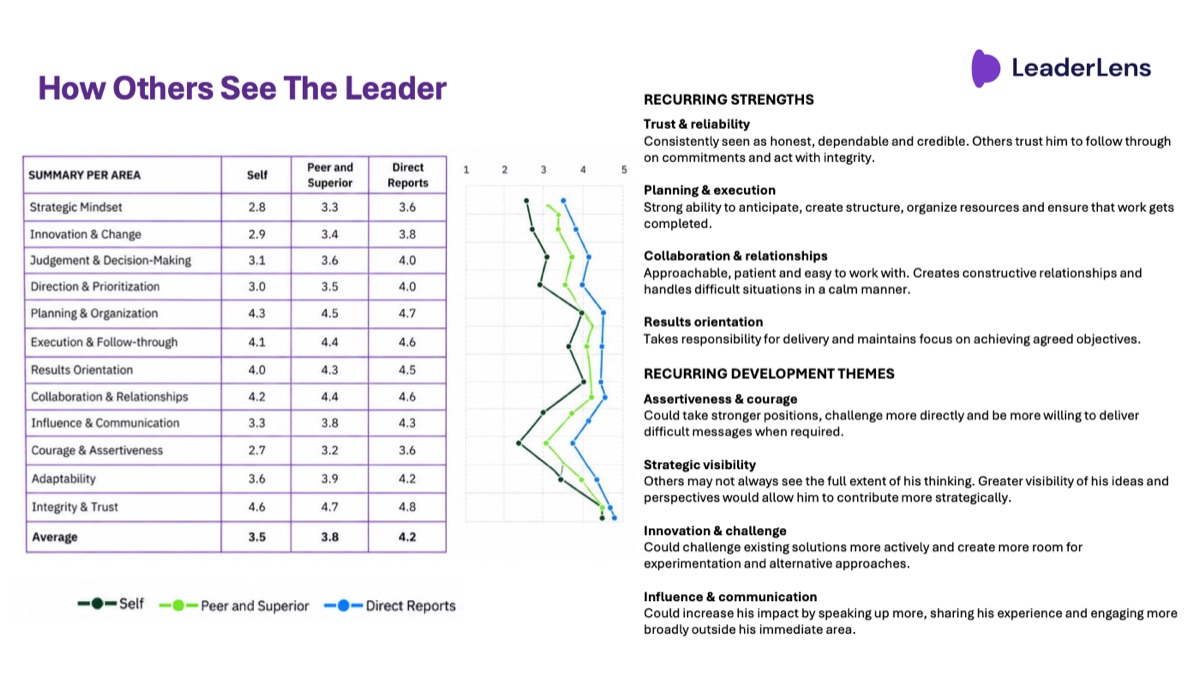
Rather than evaluating leaders against abstract ideals, we examine how they operate within their actual mandate, constraints, and expectations. Attention is paid to decision-making, judgment under pressure, authority, collaboration, and the leader’s impact on the surrounding system.

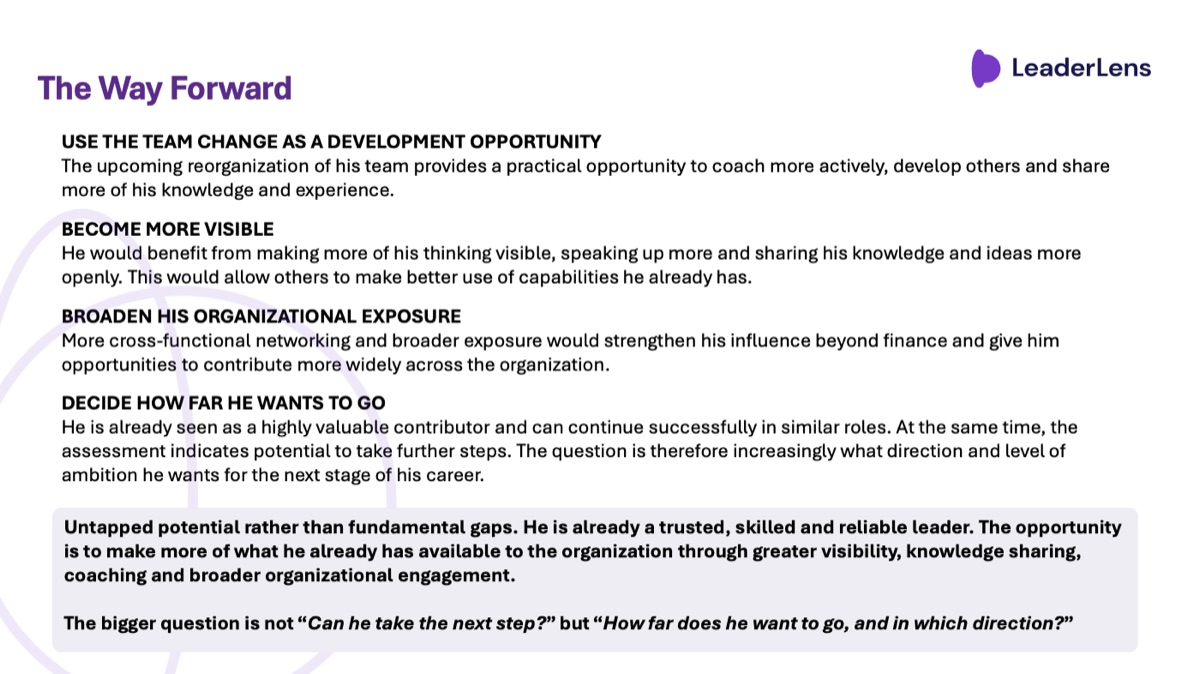
These assessments are typically used in situations where leadership quality carries significant risk or value: senior appointments, succession planning, leadership development, or periods of strategic change. The outcome is not a score, but a clear and nuanced understanding of leadership strengths, tensions, and development priorities.

Executive and leadership assessments focus on how leadership is exercised in critical roles.

Rather than evaluating leaders against abstract ideals, we examine how they operate within their actual mandate, constraints, and expectations. Attention is paid to decision-making, judgment under pressure, authority, collaboration, and the leader’s impact on the surrounding system.

These assessments are typically used in situations where leadership quality carries significant risk or value: senior appointments, succession planning, leadership development, or periods of strategic change. The outcome is not a score, but a clear and nuanced understanding of leadership strengths, tensions, and development priorities.

Boards play a decisive role in shaping leadership — often without fully seeing their own impact.

Board and ownership assessments examine how boards actually function: how decisions are made, how roles are interpreted, how authority is exercised, and how the board interacts with executive leadership. Attention is given to dynamics, alignment, and the balance between governance, support, and control.

The purpose is not to rate boards, but to create shared understanding of how the board contributes to — or constrains — leadership effectiveness and strategic execution.

These assessments are typically used by boards, owners, and investors seeking to strengthen governance, decision quality, and alignment at the top of the organization.

Leadership rarely operates in isolation.

Leadership team assessments focus on how leadership is exercised collectively: how teams make decisions, manage conflict, build trust, and take responsibility across functions. Misalignment at this level often manifests as slow execution, unclear priorities, or organizational friction.

By making team dynamics visible, these assessments allow leadership teams to reflect on how they function as a system — not just as a group of individuals. The result is a clearer understanding of collective leadership capacity and the conditions required for it to improve.

Culture is leadership at scale.

Organizational and culture assessments focus on how leadership behaviors are experienced across the organization. They explore patterns of trust, accountability, decision-making, and alignment between stated values and lived reality.

Rather than treating culture as an abstract concept, these assessments connect leadership behavior to organizational outcomes. They provide leaders with insight into how leadership is interpreted and enacted beyond the top team.

These assessments are often used as a foundation for culture development, transformation initiatives, and large-scale organizational change.

Individual leadership development begins with clarity.

Rather than focusing on abstract competencies or idealized leadership traits, development is anchored in how leadership is currently exercised in a specific role and context. This includes decision-making patterns, use of authority, interaction with others, and the leader’s impact on the surrounding system.

Development priorities are selective. Not everything can or should be developed at once. LeaderLens helps leaders focus on what matters most given their role, context, and the challenges they face. This makes development practical, relevant, and sustainable.

Coaching and reflection are used as instruments to support this process, always grounded in the insight created through assessment.

Leadership teams often underestimate the extent to which their collective behavior shapes organizational outcomes.

Team and leadership team development focuses on how leadership is exercised together: how decisions are made, how disagreements are handled, how accountability is shared, and how trust is built or eroded over time.

Development at this level is less about individual improvement and more about collective capability. It involves making interaction patterns visible and creating space for teams to reflect on how they function as a system.

By anchoring development in shared insight rather than personal opinion, teams are able to address difficult issues without personalization or blame.

Organizational culture evolves from leadership behavior repeated over time.

Culture development therefore begins with understanding how leadership is experienced across the organization. What behaviors are reinforced? What decisions are avoided? Where does responsibility actually sit? How do stated values translate into everyday action?

LeaderLens approaches culture development as a leadership-driven process. Rather than launching isolated initiatives, development focuses on aligning leadership behavior with strategic intent and organizational reality.

This creates change that is gradual but durable — rooted in how the organization is actually led.

Coaching is not a parallel activity.

Within LeaderLens, coaching is integrated into the broader leadership development process. It is informed by assessment insight and aligned with organizational context and priorities. Coaching is used to deepen reflection, support behavioral change, and help leaders navigate complexity — not to compensate for lack of clarity.

By embedding coaching within a structured understanding of leadership, development becomes coherent rather than fragmented.

Assessment only creates value when it leads to change.

LeaderLens does not treat assessment as a conclusion or a report to be delivered. It is the starting point for development that is grounded in reality rather than aspiration. Development that is disconnected from how leadership actually functions risks reinforcing assumptions instead of changing behavior.

The transition from assessment to development is therefore deliberate. It is shaped by what has been understood, not by predefined programs or generic leadership models.

Case 1 — Executive Leadership Under Strategic Pressure
A fast-growing company led by its founders was transitioning from entrepreneurial execution to organizational complexity. Growth was strong, but leadership roles and responsibilities were becoming blurred. Were the founders and leadership team ready for the next phase of growth — without losing what made the company successful? The assessment explored how leadership identity, ownership, and authority interacted. It revealed where founder strengths remained critical, and where leadership behavior risked becoming a bottleneck as complexity increased. Rather than forcing founders into predefined leadership models, development focused on evolving leadership roles in line with organizational needs. This created clarity, reduced tension, and supported sustainable growth.
Case 2 — Leadership Team Alignment in a Complex Organization
A cross-functional leadership team in a large organization struggled with execution despite strong individual leaders. Projects were delayed, accountability was unclear, and informal coordination had broken down. Was the issue individual capability — or how leadership was exercised collectively? Insight Created The assessment revealed that leadership challenges were not rooted in competence, but in interaction patterns. Decision ownership was diffuse, and unresolved tensions between functions shaped behavior more than formal structure. By making team dynamics visible, the leadership team was able to address structural and behavioral issues without personalizing them. Development focused on collective leadership capacity rather than individual coaching, leading to clearer decisions and improved coordination.
Case 3 — Board Effectiveness and Governance Clarity​
A board with experienced members and strong industry background faced increasing complexity due to growth and external scrutiny. Despite good intentions, meetings were perceived as inefficient and overly operational. How effectively was the board exercising its role — and how did it impact executive leadership? The assessment focused on how the board actually functioned: decision-making processes, role clarity, interaction with management, and internal dynamics. Differences between formal mandate and lived behavior became visible. What Changed The board gained a shared understanding of how its behavior influenced leadership effectiveness in the organization. This enabled adjustments in governance practices, clearer role boundaries, and more focused strategic discussions.
Case 4 — Founder Leadership in a Scaling Company​
A board with experienced members and strong industry background faced increasing complexity due to growth and external scrutiny. Despite good intentions, meetings were perceived as inefficient and overly operational. Leadership Question How effectively was the board exercising its role — and how did it impact executive leadership? The assessment focused on how the board actually functioned: decision-making processes, role clarity, interaction with management, and internal dynamics. Differences between formal mandate and lived behavior became visible. What Changed The board gained a shared understanding of how its behavior influenced leadership effectiveness in the organization. This enabled adjustments in governance practices, clearer role boundaries, and more focused strategic discussions.
Case 5 — Culture and Leadership During Organizational Change​
An organization undergoing restructuring experienced declining engagement and increasing internal friction. Leadership communication was frequent, but trust was eroding. How was leadership behavior experienced across the organization — and how did it shape culture during change? The assessment connected leadership behavior at different levels to cultural patterns. Gaps between stated values and lived experience became visible, particularly around decision transparency and accountability. What Changed Leadership development focused on aligning behavior with intent rather than launching new culture initiatives. Over time, this strengthened trust and reduced resistance to change.
Case 6 — Leadership Risk in an Investment Context​
An investor evaluating a potential acquisition identified leadership quality as a key risk factor. Financial performance was strong, but organizational resilience under future ownership was uncertain. Did leadership capacity match the complexity and expectations of the next ownership phase? The assessment examined leadership readiness across executive roles, decision-making maturity, and alignment between leaders. It focused on how leadership functioned under pressure rather than on past success. The insight enabled more informed ownership decisions, targeted leadership development, and clearer expectations post-transaction. Leadership risk became visible and manageable rather than implicit.
Case 7 — Leadership Development Beyond Generic Programs​
A global organization had invested heavily in leadership programs but struggled to see lasting impact. Development initiatives were well received but disconnected from day-to-day leadership reality. Why did leadership development not translate into behavioral change? The assessment revealed a disconnect between development content and actual leadership challenges. Leaders were developing skills that were not critical to their context or role. Development was refocused on a small number of leadership priorities grounded in real behavior and context. This increased relevance, ownership, and long-term impact.
Case 8 — Building Leadership Insight Over Time​
An organization sought to move beyond one-off leadership assessments and build long-term leadership capability. How could leadership insight be sustained, compared, and developed over time? By using a consistent framework and platform, leadership insight accumulated across assessments, teams, and time periods. Patterns became visible that could not be seen in isolated interventions. Leadership discussions shifted from reactive to informed. Development priorities became clearer, and leadership capacity could be tracked as the organization evolved.


Consulting. Software. Data.
One system for leadership intelligence.

The LeaderLens Platform

The Future Leadership Index (FLI)

Leadership insight becomes more valuable over time.

Each leadership assessment captures a moment. When these moments are connected, patterns emerge. Behaviors repeat, evolve, or disappear. Contexts change. Leadership capability strengthens — or erodes.

The Future Leadership Index (FLI) is LeaderLens’ way of capturing this learning.

FLI aggregates leadership data across individuals, teams, boards, and organizations, structured by context, role, and situation. It transforms isolated insight into a growing body of evidence that makes leadership comparable, interpretable, and trackable over time.

FLI is not a ranking of leaders. It is a framework for understanding leadership capacity and readiness under real conditions.

Leadership cannot be understood in isolation.

Benchmarking provides reference points that help organizations interpret what they see. Without context, numbers are misleading. With context, they become informative.

FLI enables benchmarking across multiple dimensions: organizational maturity, leadership level, industry, and situational context. This allows organizations to understand not only how leadership looks internally, but how it compares to relevant environments and expectations.

The purpose of benchmarking is not competition. It is calibration. It helps organizations distinguish between what is typical, what is exceptional, and what may require attention.

Leadership development is a trajectory, not an event.

By enabling longitudinal analysis, FLI allows organizations to see how leadership evolves. It supports reflection on whether intended changes take hold, whether new challenges emerge, and how leadership capability responds to shifting conditions.

Over time, this learning strengthens both organizational judgment and decision-making. Leadership discussions become less reactive and more informed. Development efforts become more focused. Risk becomes easier to identify early.

FLI is not static. It grows with every engagement, every assessment, and every organization that uses LeaderLens. This accumulation of structured insight is what makes leadership intelligence durable — and increasingly difficult to replicate.

About Us

LeaderLens builds on decades of work with leadership, organizations, boards, and owners across different contexts and phases of development.

Our background lies in leadership assessment, organizational diagnostics, and leadership development, shaped through extensive consulting work in complex and high-stakes environments. Over time, this work has created a deep understanding of how leadership actually functions — beyond models, trends, and surface-level explanations.

LeaderLens was formed to bring this experience together with technology and data, making leadership insight more structured, comparable, and sustainable over time.

Our experience spans individual leaders, leadership teams, boards, founders, and entire organizations.

We have worked in contexts ranging from early-stage growth companies to large, established organizations, and from stable operating environments to periods of significant transformation. This breadth matters, because leadership does not look the same everywhere.

LeaderLens reflects this diversity of experience. It is designed to work across contexts without reducing leadership to a single model or definition.

We believe leadership matters too much to be handled casually.

Leadership cannot be reduced to personality, position, or intention. It must be understood as behavior in context, shaped by systems, constraints, and responsibility.

LeaderLens exists to support that understanding.

We believe leadership matters too much to be handled casually.

Leadership cannot be reduced to personality, position, or intention. It must be understood as behavior in context, shaped by systems, constraints, and responsibility.

LeaderLens exists to support that understanding.

Start a Conversation

COMING SOON

ANDERS FINNE

+358 40 1679061

COMING SOON